
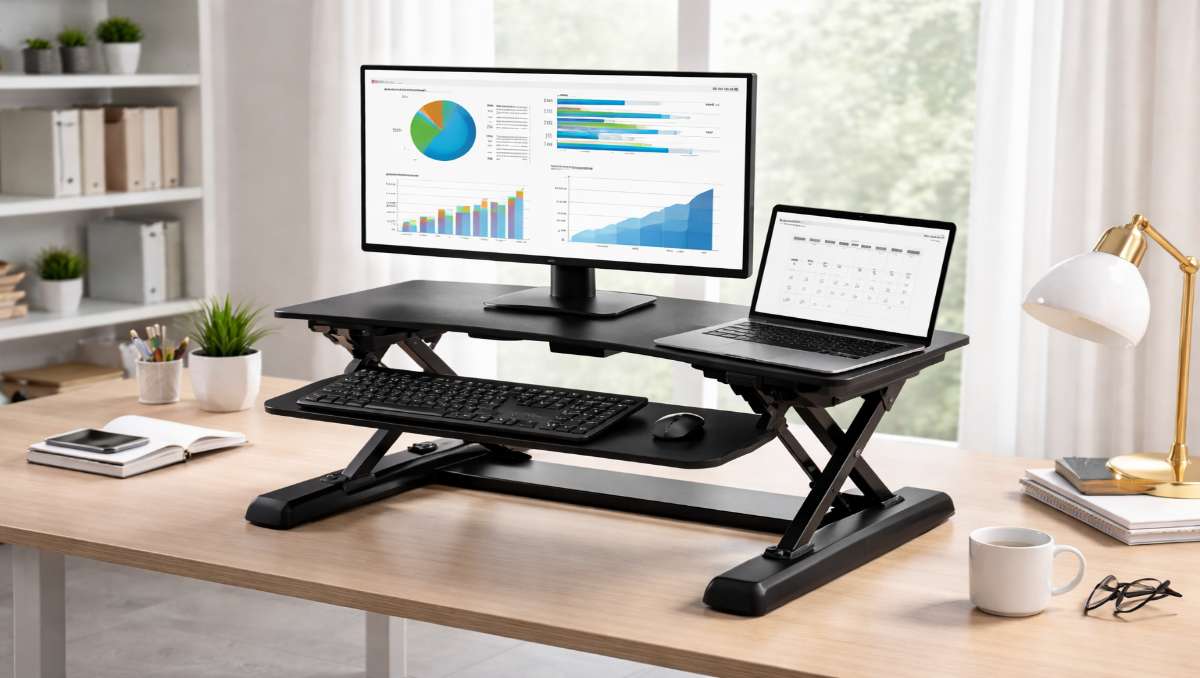
Modern workplaces are changing as companies place greater emphasis on employee well-being, comfort, and productivity. One office solution that has gained significant attention in recent years is the riser desk. But what exactly is a riser desk, and how does it fit into today’s work environment? It is often associated with standing workstations and improved ergonomics, but its role in the workplace goes beyond simply changing how a desk looks.
Key Takeaways
- A riser desk converts any standard desk into a sit-stand workstation.
- It supports ergonomic posture and reduces strain from prolonged sitting.
- It offers a cost-effective alternative to full standing desks.
In this article, we will explore what a riser desk is, what it is used for in a modern workplace, and why more companies are incorporating it into their office setups.
What Is a Riser Desk?
A riser desk (or desk riser) is a workstation accessory that sits on top of a traditional desk and raises key work items such as monitors, laptops, keyboards, and other desk essentials. Instead of replacing the entire desk, it functions as an adjustable platform that allows users to elevate their work surface to a more comfortable height.
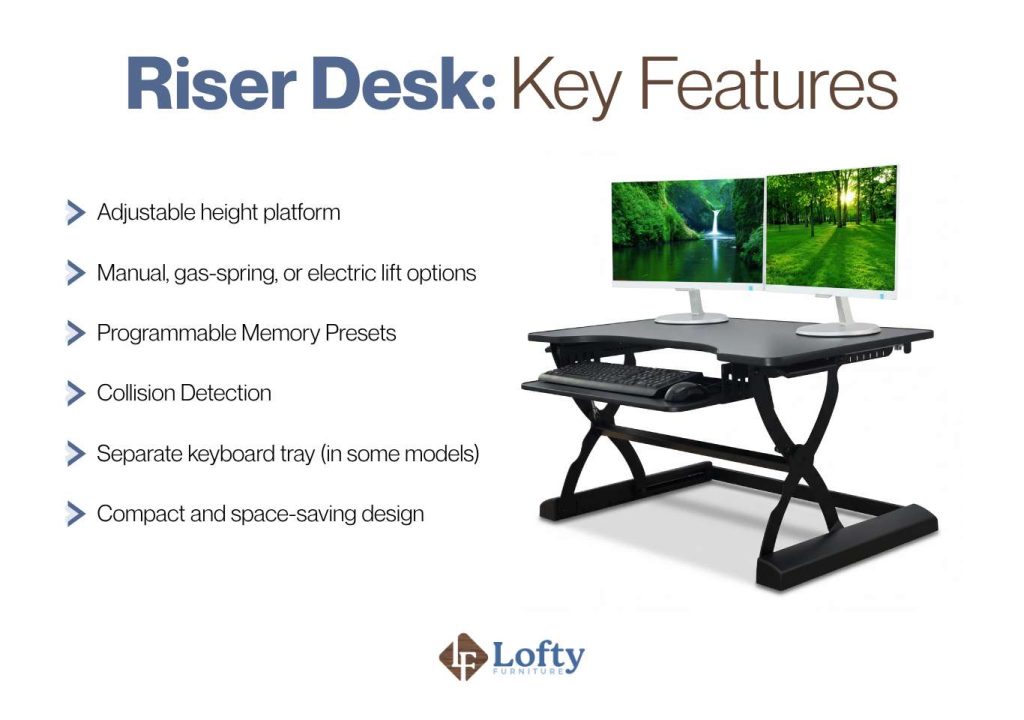
So, how does a rising desk work? A rising desk works through a built-in lifting mechanism that allows the platform to move up or down smoothly. Depending on the model, this mechanism may be manual (using a lever or handle), spring-assisted for easier lifting, or powered by an electric motor for effortless height adjustments.
Types of Riser Desks
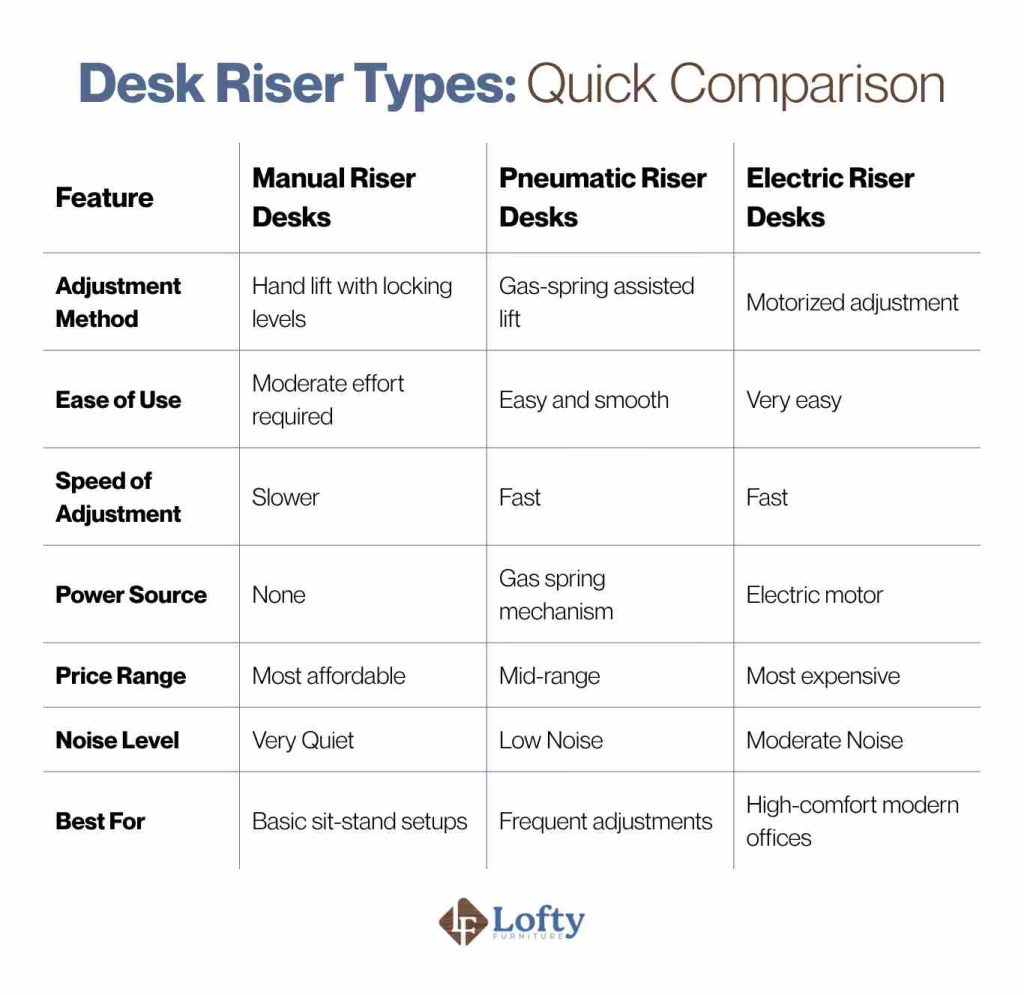
Riser desks come in several designs, each offering different ways to adjust the height of a workstation.
Manual Riser Desks
Manual desk risers are the simplest and often the most affordable type. They require the user to adjust the height by hand, usually by lifting the platform and locking it into preset height levels. Because they do not rely on motors or pressurized systems, they tend to have fewer mechanical parts and are generally easy to maintain, making them ideal for students, budget-conscious users, and those who only occasionally switch between sitting and standing.
Pneumatic Riser Desks
Pneumatic desk risers use a gas-spring mechanism to assist with lifting and lowering the platform. With the help of a lever or handle, the user can smoothly adjust the height without needing to apply much force. This design allows for quicker transitions between sitting and standing positions, making them a great fit for everyday users, home office workers, and professionals who adjust their desk height multiple times throughout the day.
Electric Riser Desks
Electric desk risers are powered by a small motor that raises and lowers the platform with the push of a button. This type offers the most convenience since the adjustment process is automated and typically very smooth. Some electric desk risers even include programmable height settings, making them especially suitable for busy professionals, multi-monitor setups, and users who prioritize comfort and frequent adjustments with minimal effort.
Key Benefits of Using a Riser Desk at Work
To implement effective suggestions for a better workplace, many companies are adopting riser desks to create more adaptable and ergonomic environments. These desks offer several advantages:
Reducing Sedentary Work Habits
One of the most significant advantages of a desk riser is its ability to reduce prolonged sitting. Many office workers spend the majority of their day seated, which has been linked to various health concerns. Studies show that sit-stand workstations can significantly reduce sitting time and encourage more movement throughout the day, helping address sedentary workplace habits.
Improving Posture and Spine Alignment
A properly adjusted desk riser helps position your monitor at eye level and your keyboard at a comfortable height. This alignment reduces strain on the neck, shoulders, and lower back, which are the common problem areas for desk workers. Over time, better ergonomics can help reinforce healthier posture habits and minimize discomfort caused by slouching or leaning forward.
Increasing Energy and Productivity
Alternating between sitting and standing may help reduce fatigue during long work sessions. Many workers report feeling more alert and engaged when they have the option to change positions throughout the day. Research suggests that sit-to-stand desks can improve work engagement and may support productivity without negatively affecting job performance.
Easier Workspace Customization
Desk risers offer a simple and cost-effective way to upgrade an existing workstation. Instead of investing in a full standing desk, users can place a riser on top of their current desk and adjust it as needed. This makes it easier to tailor the workspace to individual comfort preferences, whether at home or in a shared office environment.
Potential Drawbacks of Riser Desks
While desk risers provide ergonomic benefits, they may not suit every workspace. Because they sit on top of an existing desk, they can reduce available workspace and require users to reach down for items placed on the lower surface. Stability can also be a concern, especially when supporting multiple monitors or heavier equipment, as some models may wobble during use.
Desk risers typically offer a more limited height adjustment range compared to full standing desks, which can make it difficult for users of different heights to find an ideal position. In addition, they depend on the size and stability of the underlying desk, making them less suitable for smaller, curved, or cluttered workstations.
Riser Desk vs Standing Desk vs Adjustable Desk Converter
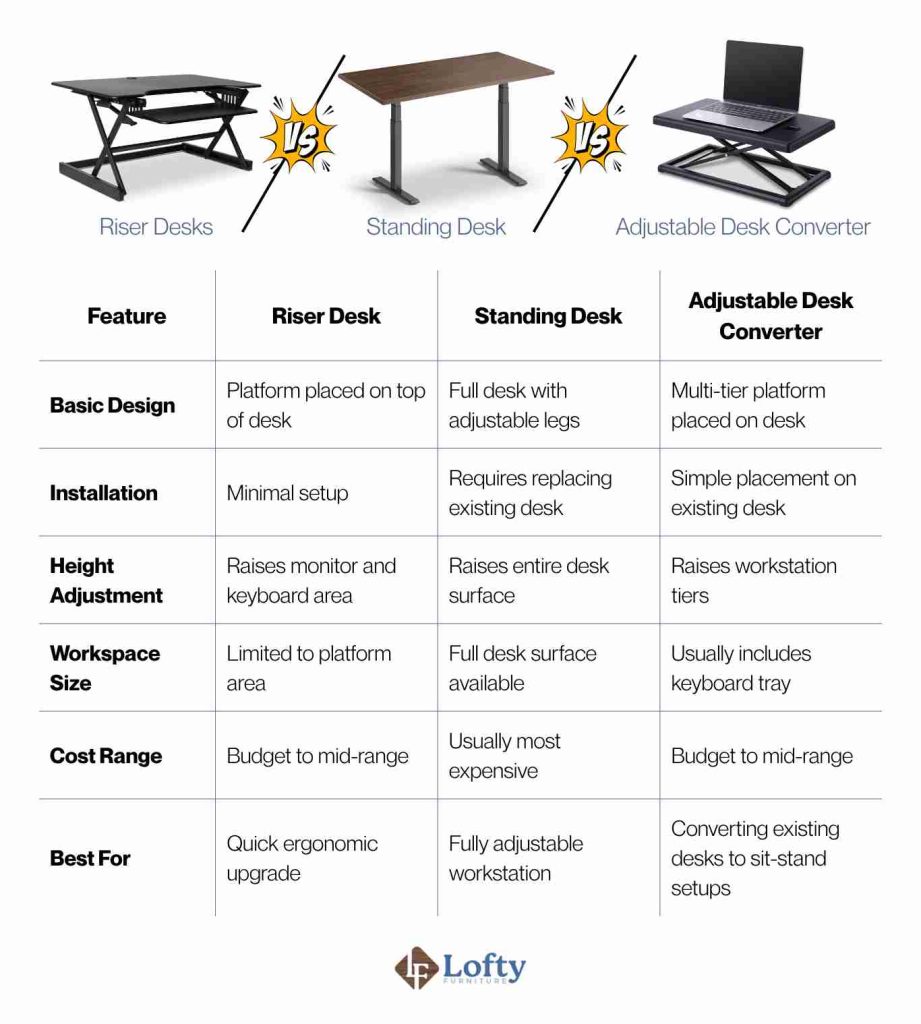
Riser desks, standing desks, and adjustable desk converters are all designed to support more flexible workstations, but they function in slightly different ways. A riser desk is typically a platform placed on top of an existing desk that raises monitors and keyboards to a more comfortable height. A standing desk, on the other hand, replaces the entire desk and has height-adjustable legs that allow the whole surface to move up or down.
An adjustable desk converter is closely related to a desk riser and is sometimes used interchangeably with the term. However, desk converters often include multi-tier platforms and keyboard trays designed specifically to convert a standard seated desk into a sit-stand workstation.
Here’s a detailed comparison:
How to Use a Riser Desk Correctly
Using a desk riser properly is important to gain its ergonomic benefits and avoid discomfort during long work sessions.
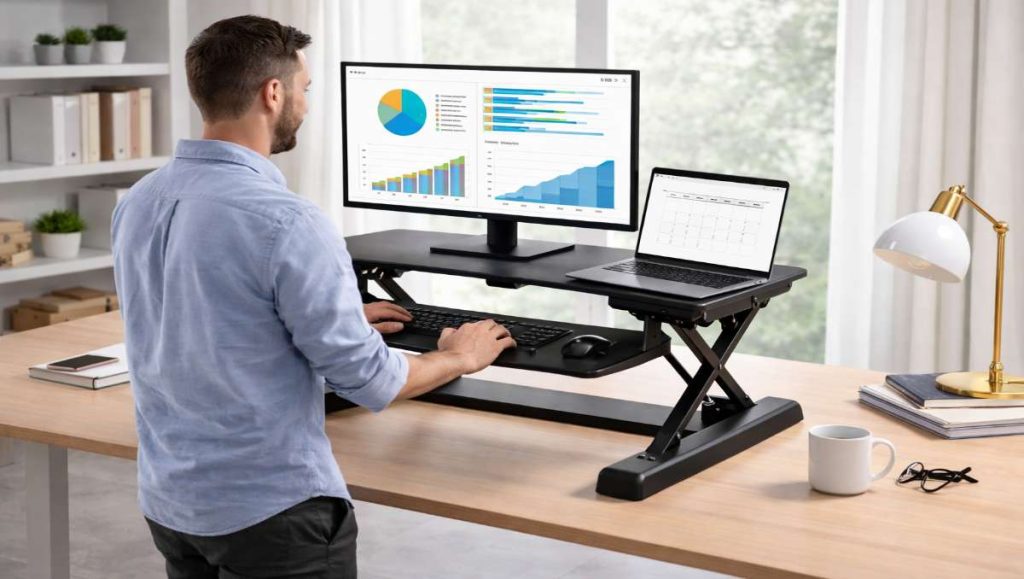
1. Adjust Monitor Height to Eye Level
The top of the monitor should be at or slightly below eye level when standing. This helps keep the neck in a neutral position and prevents users from looking down or tilting the head upward for extended periods.
2. Maintain Proper Keyboard and Wrist Position
The keyboard should be placed so that your elbows remain close to your body and bent at about a 90-degree angle. Wrists should stay straight and relaxed while typing to reduce the risk of strain or repetitive stress injuries.
3. Alternate Between Sitting and Standing
A desk riser is most effective when users alternate between sitting and standing rather than staying in one position all day. Many experts recommend switching positions every 30 to 60 minutes to maintain comfort and reduce fatigue.
4. Use an Anti-Fatigue Mat and Keep Desk Accessories Within Reach
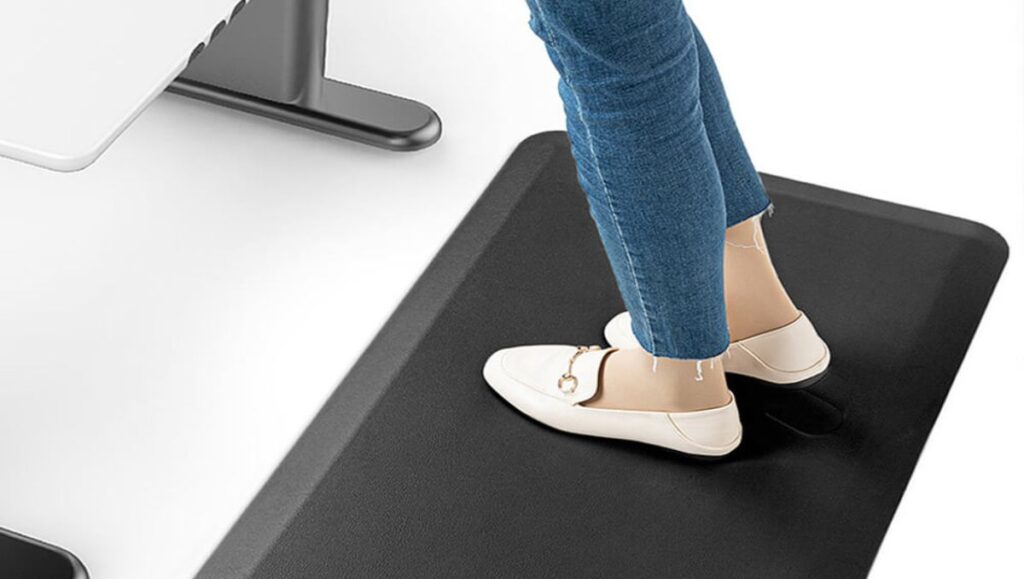
Standing for long periods on a hard surface can cause discomfort in the feet and legs. An anti-fatigue mat or standing desk mat provides cushioning and helps reduce pressure on the lower body while standing. Additionally, frequently used items such as a mouse, notebook, or phone should be placed within easy reach on the desk riser.
Ready to upgrade your workspace? Experience the perfect blend of traditional craftsmanship and modern ergonomics by investing in a handcrafted Amish adjustable desk.
Conclusion: Why Riser Desks Are a Smart Upgrade for Modern Workspaces
A riser desk is a simple workstation upgrade that elevates your monitor and keyboard on top of an existing desk, making it easier to switch between sitting and standing while working. Instead of replacing the entire desk, it provides a flexible way to improve ergonomic design and encourage healthier work habits.
In modern workplaces where comfort and productivity matter, riser desks offer a practical solution for creating a more adaptable workspace. They help reduce long periods of sitting, support better posture, and allow employees to customize their work setup with minimal cost or installation.
Frequently Asked Questions
Can a desk riser replace a standing desk?
In many cases, yes. A desk riser can convert a traditional desk into a sit-stand workstation without replacing the entire desk. However, a full standing desk may provide a larger work surface and a wider height adjustment range.
What does a desk riser look like?
A desk riser typically looks like a compact platform that sits on top of an existing desk. It often has a flat upper surface for monitors or laptops and a lower tier for a keyboard and mouse. Most designs feature a sturdy frame with a lifting mechanism underneath, allowing the entire structure to move up and down.
How high should a desk riser be?
The ideal height of a desk riser depends on your body and setup, but generally, it should raise your screen to eye level and position your keyboard so your elbows are at about a 90-degree angle. For most users, this means the top platform sits roughly 30 to 50 cm (12 to 20 inches) above the desk when standing.
What is the weight limit for a desk riser?
Weight limits vary by design and build quality, but most desk risers can support between 10 to 20 kg (22 to 44 lbs). Heavier-duty or electric models may handle up to 30 kg (66 lbs) or more.
Is a desk riser necessary?
A desk riser isn’t strictly necessary, but it can be highly beneficial if you spend long hours at a desk. It allows you to alternate between sitting and standing, which can help reduce back and neck strain, improve posture, and increase overall comfort.