
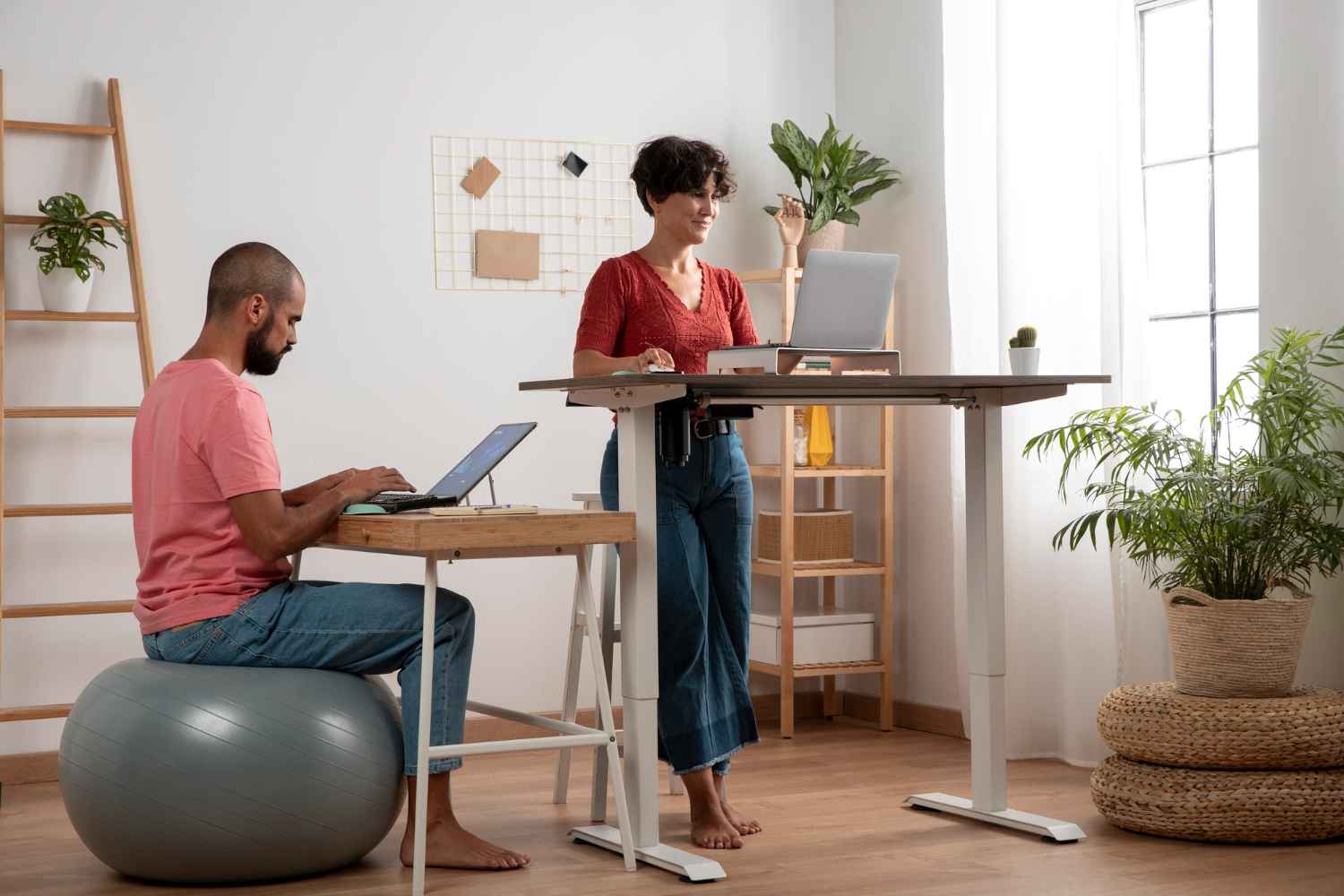
If you want to work comfortably at a standing desk, the best standing desk chair should support your posture, match your desk’s height range, and let you move between sitting and standing without a second thought. The right seat makes those transitions feel natural while giving your back, legs, and feet the support they need through a full workday.
Key Takeaways:
- A good standing desk chair encourages movement, helping reduce fatigue and improve circulation.
- Look for adjustable seat height, tilt, and lumbar support so you can match the chair to your body and your desk height for better posture and comfort.
- Choose the type that suits your work style — a wobble stool for movement, a perch stool for a semi-standing position, or a full task chair if you still sit most of the day.
Why Your Chair Matters When Using a Standing Desk
Traditional sitting for extended periods is linked to several health risks, including obesity, heart disease, and type 2 diabetes, according to research from the Mayo Clinic. But standing all day is not necessarily the answer either. Prolonged standing can contribute to fatigue, joint stress, and circulation problems, as noted in ergonomic research.
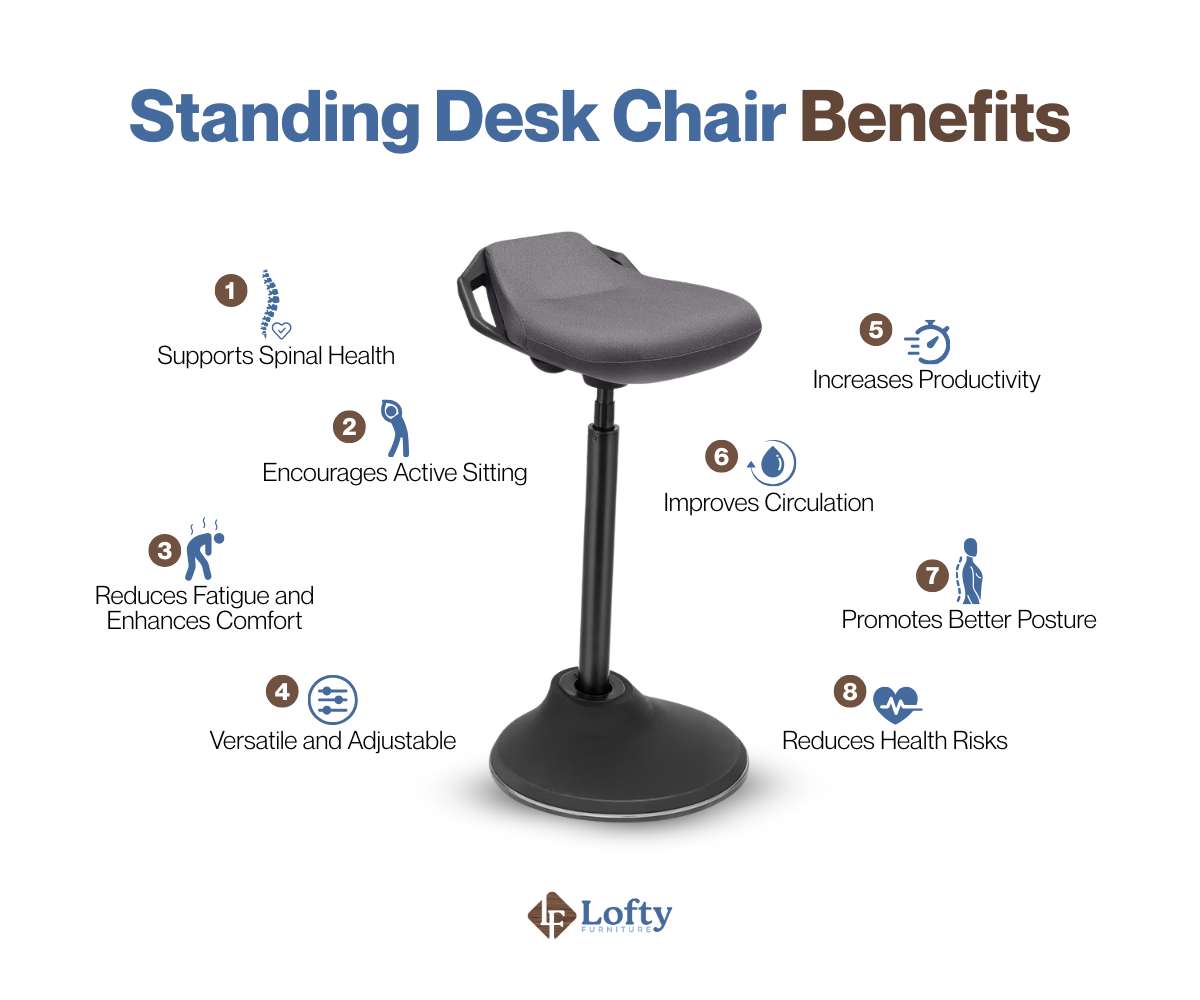
This is where the right standing desk chair can make a real difference, giving you a comfortable way to shift between sitting and standing throughout the workday. A well-designed chair can encourage subtle movement, provide better support, and help you maintain a more natural posture. When your setup feels comfortable enough to change positions regularly, you can give your body a break without completely stepping away from your work.
Types of Standing Desk Chairs
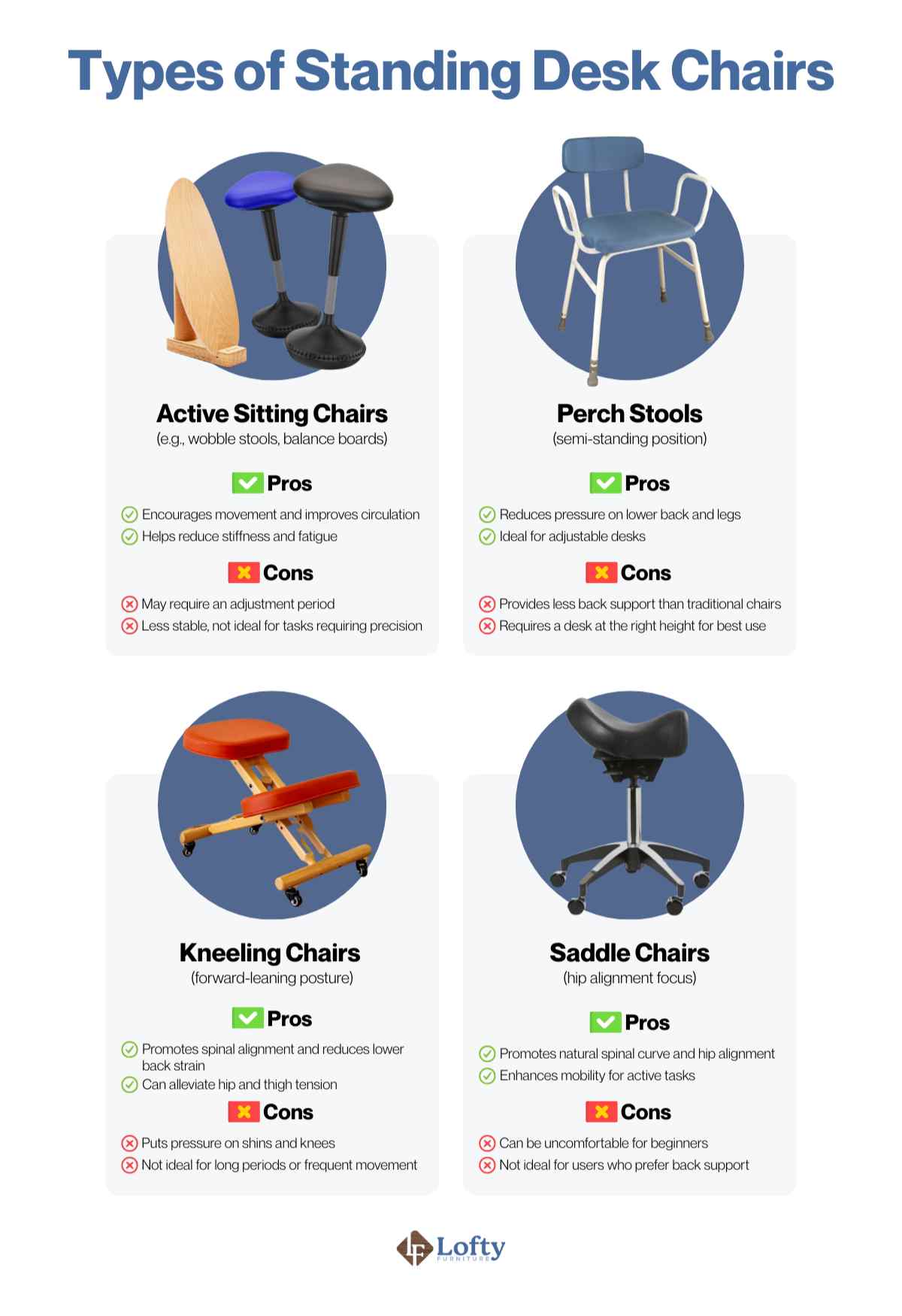
Different chairs solve different problems, and the right one depends far more on your sit-to-stand ratio than on which type sounds healthiest.
Wobble and Active-Sitting Chairs
These sit on a rounded or tilting base that keeps small stabilizing movements going while you work. That constant micro-movement engages the core and reduces the stiffness that comes from holding one position. The tradeoff is that stabilizing takes low-level effort, so most people find them better in stretches of 30 to 60 minutes than as an all-day seat.
Best for: breaking up long stretches and staying alert during routine tasks.
Skip it if: you have balance concerns or need a stable base for detailed work.
Sit-Stand Perch Stools
Perch stools hold you in a semi-standing position with your hips open past 90 degrees and your weight shared between the seat and your feet. Most adjust somewhere between 22 and 34 inches, which is what makes them the natural partner for a height-adjustable desk. They take pressure off your lower back and legs without asking you to commit to fully sitting down.
Best for: anyone standing more than half the day.
Skip it if: you spend most of your day seated and need lumbar support for long focused stretches.
Kneeling Chairs
A kneeling chair tips you forward and shifts part of your weight onto your shins, which opens the hip angle and can ease lower back strain. The pressure has to go somewhere, though, and for many people that means sore shins and reduced lower-leg circulation after an hour or two.
Best for: short focused sessions and people who slouch when seated normally.
Skip it if: you have knee or shin sensitivity, or you need to get up frequently, since exiting a kneeling chair is slower than any other option here.
Saddle Chairs
Saddle seating splits your legs around a contoured seat, which rolls your pelvis forward and helps the lower spine keep its natural curve. Expect an adjustment period of a week or two, since the posture is unfamiliar and it uses core and hip muscles most desk workers have not engaged in a while.
Best for: people who want an open hip angle and freedom to reach and pivot.
Skip it if: you want to lean back and think, since saddles have little or no backrest.
Full Ergonomic Task Chairs
The honest answer for a lot of home offices. If you follow something close to a 20-8-2 pattern you are still seated for roughly two thirds of the day, and a proper task chair with adjustable lumbar support, seat height, and armrests will serve those hours better than any stool. Many pair well with a lift desk at its lower settings and simply move aside when the desk goes up.
Best for: anyone who sits more than they stand.
Skip it if: your desk lives at standing height most of the day.
Key Features to Look for in the Best Standing Desk Chair
These features ensure that the chair complements your standing desk setup and promotes a healthy, productive work environment.
Adjustability and Comfort
Look for a chair with adjustable seat height, tilt, and lumbar support to customize it for your body and desk, promoting proper posture and comfort. High-density foam, breathable mesh, and contoured backrests reduce discomfort, pressure points, and overheating, making long hours more comfortable.
Durability and Stability
Durability is key for long-term use. Look at what the base and frame are actually made of — a welded steel base outlasts a cheap nylon star, and it’s the difference between a chair that shrugs off years of sit-stand transitions and one that develops a wobble by month six. Be sure to check weight capacity ratings to ensure the chair can safely support you.
Mobility
A chair with swivel and caster features adds flexibility to your workspace. A 360-degree swivel allows for easy turning, while smooth-rolling casters make it effortless to move across different floor types. Make sure the casters are suitable for your floor surface to avoid damage or resistance.
Enhance your ergonomic setup beyond a standing desk chair. Explore our selection of modern ergonomic chairs for ultimate comfort and support.
How to Match Your Chair with Your Standing Desk

The right standing desk chair only works as well as the setup around it. Before settling into your workday, take a few minutes to adjust the chair and desk together so everything feels natural when you switch between sitting and standing.
1. Measure Your Desk and Chair Height
Start with your desk’s full travel range, both the lowest and highest settings, and write both numbers down. Subtract 10 to 12 inches from each to get the seat heights you actually need, then check that against the chair’s stated seat height range. You should be able to work at either desk position without reaching upward for your keyboard or lifting your shoulders.
2. Find a Comfortable Seating Position
Once you’ve confirmed that the heights work together, adjust the chair until your body feels relaxed and supported. Your feet should be able to reach their support surface, your knees should feel comfortable, and your arms should rest naturally when using the keyboard and mouse.
3. Make Sure Your Feet Have Proper Support
A built-in foot ring can give your feet somewhere stable to rest, while a separate footrest can work well if the chair or desk setup needs additional support. The goal is simple: your feet should not be left dangling for long periods while you work.
4. Adjust Your Backrest, Keyboard, and Monitor
After setting the seat height, adjust the backrest so it supports your back without forcing you into a rigid position. Then check your keyboard, mouse, and monitor because raising or lowering the chair can change how the rest of your workstation lines up.
5. Build an Easy Sit-to-Stand Routine
Keep the chair somewhere you can move onto it without repositioning anything, then raise or lower the desk to match. If you want a starting structure, Cornell’s 20-8-2 pattern is a reasonable default: 20 minutes seated, 8 minutes standing, and 2 minutes moving, repeated through the day.
Conclusion: Finding the Best Standing Desk Chair For You
The best standing desk chair is the one that fits how you actually work, not the one with the longest spec list. A seat height that overlaps your desk range, somewhere solid for your feet, and adjustments you can make without standing up will do more for your workday than any single premium feature.
At Lofty Furniture, we build our desks and chairs to work as one setup rather than two purchases. Our lift desks pair Amish solid wood tops with German-engineered bases, and our chairs come from the same workshops, so the wood and stain actually match across the room. Browse the full chair collection to find the seat that fits your desk range.
Frequently Asked Questions
Can a standing desk chair replace a regular office chair?
Yes, a standing desk chair can replace a regular office chair, especially if you use a standing desk. However, it’s essential to choose a chair that provides adequate support and adjustability for both sitting and semi-standing positions.
What height chair do I need for a 42-inch standing desk?
Aim for a seat height of roughly 31 to 33 inches, which keeps your forearms level with the desktop. Most sit-stand stools reach that range, though many top out near 33 to 35 inches. Measure your desk at both its lowest and highest settings so one chair covers both.
Are standing desk chairs suitable for people with back pain?
Many standing desk chairs are designed to alleviate back pain by promoting better posture and reducing spinal strain. Chairs with adjustable lumbar support, such as kneeling or saddle chairs, can be particularly beneficial.
How tall should a standing desk chair be for optimal ergonomics?
The ideal height of a standing desk chair depends on your height and the height of your standing desk. Generally, your feet should be flat on the floor, your knees should be at a 90-degree angle, and your hips should be slightly higher than your knees when seated.
Do standing desk chairs help with weight loss or calorie burning?
While standing desk chairs, especially active sitting chairs, can encourage movement and increase calorie expenditure compared to traditional sitting, they are not a primary tool for weight loss. The subtle movements and postural changes can contribute to a slight increase in calorie burn, but the effects are generally minimal.
Can I use my existing office chair with a sit-stand desk?
Often yes, especially if your desk lowers to a standard 28 to 30 inch seated height. The limitation is that a standard task chair usually tops out around 21 inches of seat height, so it cannot follow the desk up into a perched position. Many people keep the task chair for seated work and add a stool for the raised setting.